EDUCATION 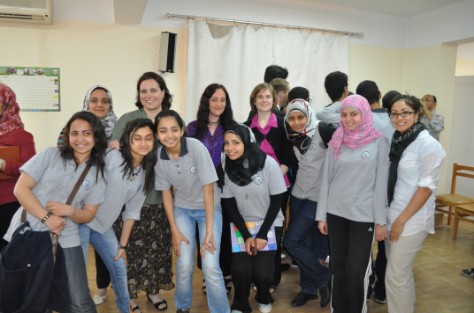
Wow! Wednesday was an exciting day as our group met with several 9th and 10th grade students. We had a thought provoking round table discussion on all sorts of topics of importance to their young lives, including the recent revolution in Egypt. We asked how many of them had facebook and practically all hands went up! We asked them how what they like to do for fun and they said they liked:
Did you know? There are private and public (government) schools in Egypt. We visited a private language school. A typical school day in this school goes from 7:4o until 2:2o, Monday through Thursday and Saturday. Friday is the Muslim day of rest and therfore a day off from school. There is school on Saturday and Sunday is another day off from school. Subjects taught: Math, Science, Computers courses are all taught in English while Social Studies, Arabic Religion, Art, Music, and Physical Education are taught in Arabic. There are around 45 students in each class. 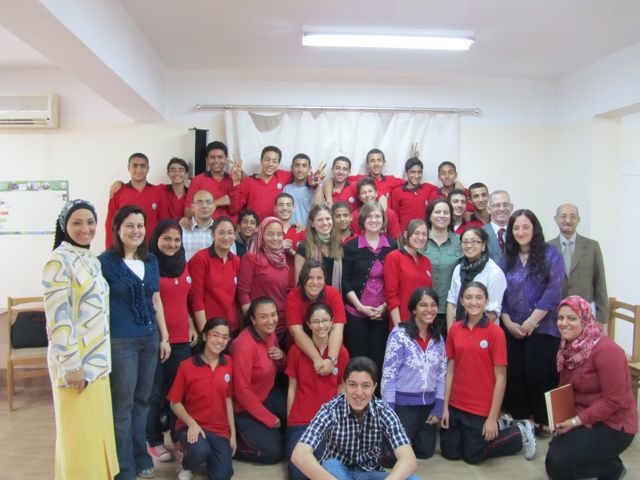 "You too can start a revolution!" What issues matter to you? What would be your revolution? FOREIGN POLICY AND DOMESTIC SITUATION 
On Thursday we were honored to hear Moheb Zaki, executive director of the Ibn Khaldun Center in Cairo speak on politics and parties in post-revolution Egypt. (Photo courtesy of Paul Beran) 
In the afternoon we heard professor Riham Bahi from the Cairo University and the American University in Cairo speak on the issue of reform in the new Egypt. Both presenters shared that the revolution took them by surprise and both expressed cautious optimism for the future of the new Egypt saying that the revolution was just the beginning of a long process of political and social change. (Photo courtesy of Paul Beran) 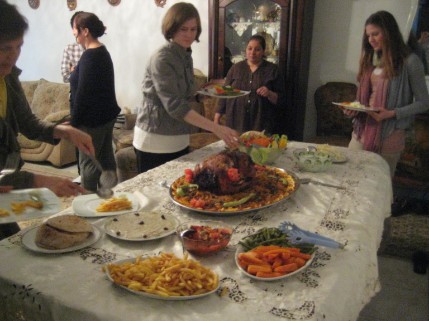 Thursday evening we had a lovely dinner with some friends of the Harvard Egypt Forum. 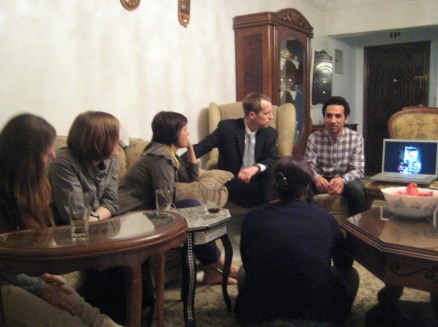 We listened with wrapped attention as one family member spoke of his experience in Tahrir Square during the January 25th revolution. ANCIENT ALEXANDRIA  Hi, I'm Muffy and I'm going to tell you about Ancient Alexandria. 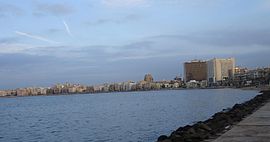 On Friday we went to the port city of Alexandria. The city of Alexandria sits on the Mediterranean Sea and today has a population of 4.1 million. It was believed to have been founded by Alexander the Great in 331 BCE and was the capital of the Greco-Roman world for over six centuries. It was also home to one of the seven wonders of the ancient world-The Pharos Lighthouse. When Cleopatra ruled from Alexandria, this city matched Rome in everything but military power. Under Roman control, Alexandria remained the capital of Egypt but by the 4th centruy war, famine and disease beagn to mark the city's loss of prominence and in 7th century CE the Muslim armies swept into Egypt and moved the capital to Cairo, marking the end of this ancient metropolis. 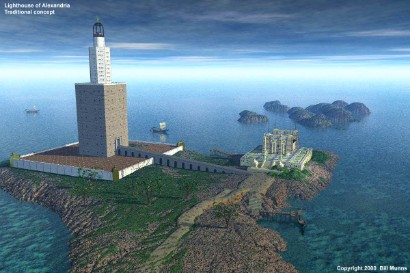 This is the Pharos Lighthouse as it once looked when it stood in ancient Alexandria. The lighthouse was constructed in 280 BCE and was in use until 1323 when an earthquake toppled it. The lighthouse helped guide sailors into the harbor of Alexandria at night time. |
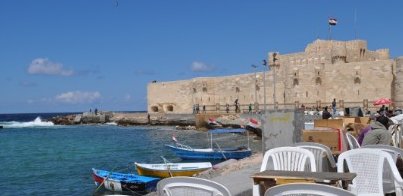 Fort Qaitbey was built by the Mamluk Sultan Qaitbey in 1480 CE. It sits on the remains of the legendary Pharos lighthouse. 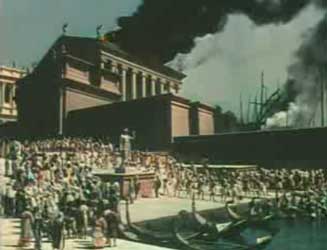 The Great Library of Alexandria was the largest and most significant library of the ancient world. It held all the know knowledge of the ancient world. The Great Library of Alexandria was destroyed in part by a fire in 48 BCE. 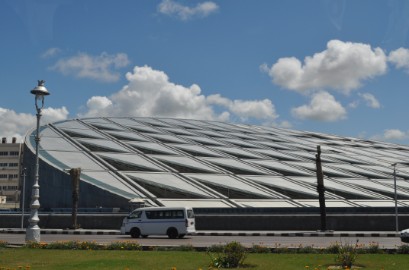 This is the Bibliotheca Alexandrina opened in 2002 in commemoration of the ancient library that stood once on the same spot. 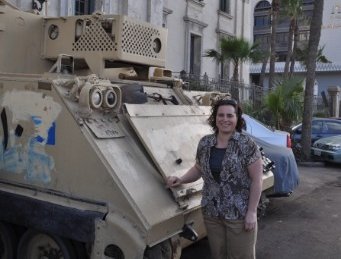 Ms. Avery posing in front of a tank in downtown Alexandria. The people of Alexandria also took part in the popular uprising that started on the 25th of January. 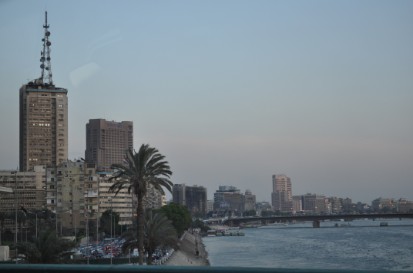 The Nile River runs through Cairo. The Nile river is the longest river in the world and the only river to run northward. 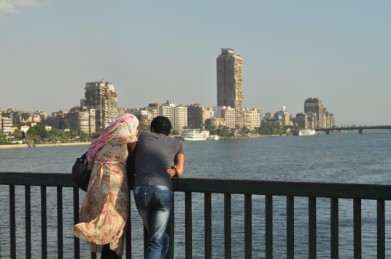 A stroll along the Nile 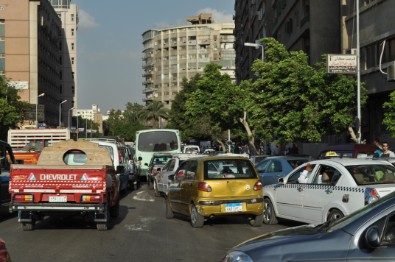 Cairo is home to 20 million people and therefore there is a great amount of traffic. 
Photo of traffic (courtesy of Paul Beran). 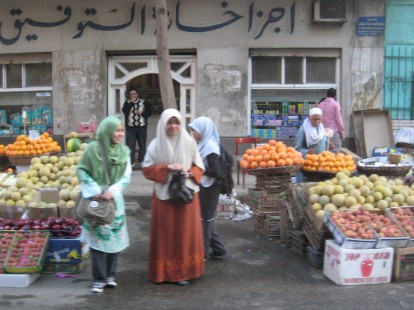 Food in Egypt can be bought in Supermarkets and in small street side markets and stalls. 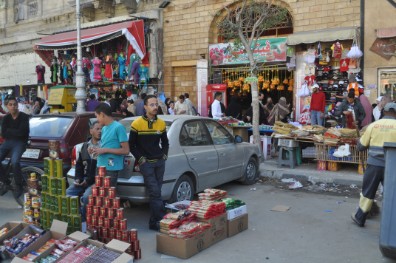
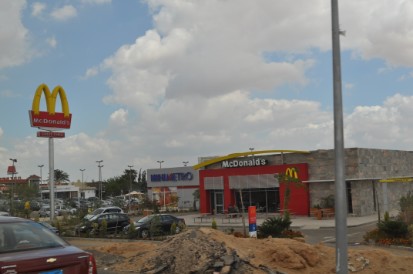 Egyptians also eat in restaurants including fast food restaurants such as this McDonald. 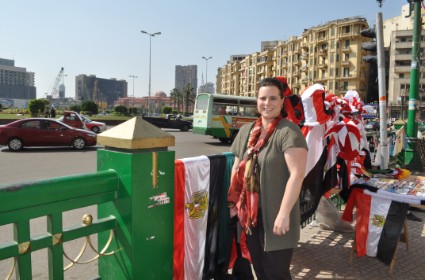 Saturday was our last day in Egypt and we spent part of the day shopping in the downtown area. Here I am in Tahrir Square, site of the revolution that started on January 25th. For 18 days in January and February this square was filled with hundreds of thousands of protestors, demanding change in their government. In the end, the mass non-violent movement succeeding in bringing about the end of the 30 year reign of President Hosni Mubarak. 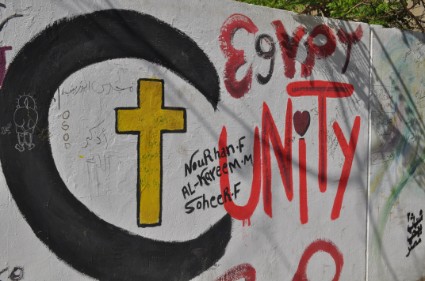 |
